Stagflation is coming - historically the optimal environment for gold and silver
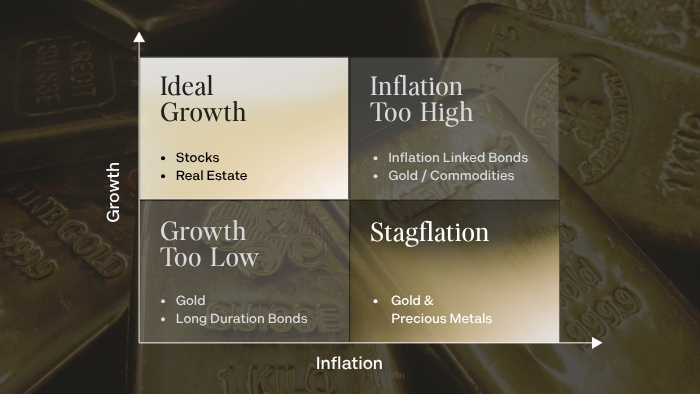
The world is facing a perfect storm of economic pressures — one that, taken together, points toward stagflation: the most challenging economic environment for most asset classes, and historically the best for gold and silver.
Three key supply chains are breaking at once
The ongoing conflict in the Middle East is doing far more than disrupting oil markets. It is simultaneously threatening the supply chains behind semiconductors and food — two pillars of the modern economy.
Consider semiconductors first. The vast majority of the world's advanced chips — the kind that power Nvidia's AI processors — are produced in Taiwan. That production depends critically on helium gas, and Taiwan sources most of its helium from Qatar's Ras Laffan facility, which accounts for roughly 35% of global supply. Iranian strikes have already damaged Ras Laffan, and Qatari authorities have stated repairs could take years. Taiwan has no clear alternative and will have to compete for whatever limited supplies remain with South Korea and other Asian nations. Higher technology prices are a near certainty.
Food is equally at risk. The Gulf states are the world's largest exporters of fertilizers and oil-derived agricultural chemicals — roughly a third of globally traded fertilizer passes through the Gulf. A prolonged disruption will flow directly into reduced crop yields and higher food prices worldwide. China's announcement on mid-March of fertilizer export restrictions adds further pressure, effectively removing another major source from global markets.
Sweeping tariffs and trade restrictions between major economies are compounding all of the above, raising the cost of imported goods across the board. The pattern is clear: prices are rising not because the economy is thriving, but because the supply of goods is being constrained. That is the classic definition of stagflation — high inflation combined with low or stagnant growth.
What history tells us
During the last great stagflationary period, from 1970 to 1981, gold appreciated at an average of 26% per year — its strongest sustained performance on record. The reason is straightforward: bonds, equities, and real estate all struggle in stagflation. Companies face rising costs and falling demand, pushing toward bankruptcy. Real estate withers as financing costs rise and buyer affluence falls. Bonds fail to generate real returns as inflation surges. Central banks are forced to raise interest rates sharply to prevent currencies from spiralling — and there are no good options, only less bad ones.
In this environment, physical precious metals shine. They carry no counterparty risk, no jurisdictional vulnerability, and no dependency on the health of the financial system. Beyond performing well during the crisis itself, physical metals preserve liquidity when the storm passes and better investment opportunities emerge.
A note on short-term gold and silver price movements
The points above reflect fundamental, structural realities that will shape precious metals prices over the long term. They say nothing about what prices might do next week. In the short term, expect contradictory movements and confusing headlines. Two things are worth keeping in mind:
- Spot prices are predominantly set by paper traders, who may be forced to sell to cover losses elsewhere in falling markets.
- Physical metal availability is driven by a different force entirely: market participants who choose to take delivery and hold real metal rather than paper claims.
As the market runs short of physical "free float" — as briefly occurred in October 2025 — the ability of paper traders to suppress prices becomes increasingly constrained. When exchanges cannot meet physical demand, prices must rally to reflect physical reality rather than paper positioning.
Secure physical metals for the long term
We are now vaulting over 600 tons of silver for our clients at The Reserve — more than 2% of global silver supply, exceeding the silver inventories of the Shanghai Gold Exchange. With silver spot prices roughly 45% below their earlier peak and physical supply tightening, this may be a timely moment to consider adding to your holdings.
View This is When Gold and Silver Do Well for an analysis of how gold and silver perform in different economic macro-environments.
Sincerely,
Gregor J. Gregersen
Physical Silver Supply and Demand Update
Visible inventories tracked by major exchanges from New York to Shanghai are either falling or sitting well below their long-term averages. A recent Bloomberg article – China Pulls Silver From Global Markets to Meet Surging Demand - reported that Hong Kong premiums have been as high as 8 USD for silver in the first two months of 2026.
Comparatively, we have been able to maintain premiums of USD 3 to 4 per ounce for our clients here in Singapore throughout most of 2026. However, premiums across Asia are now rising — we received notice of increasing premiums from suppliers last week.
All of this suggests that metal remains scarce across the broader system, and the institutional physical silver market has reason to be concerned.
Scalability / Upgrades – Customer Service
In the first two months of 2026, we hired 10 new staff to cope with rapidly growing client demand, and we are continuously improving our procedures to provide you with better, more consistent service.
Better communication, starting now
One key area we are improving is how we communicate with you. Email, while familiar, is inherently neither the safest, most efficient, nor most reliable communication channel. We are therefore upgrading our entire customer service and relationship management team to use our in-house secured notification system — a tool many of you will already know, as it has been part of your Silver Bullion account for over a decade.
The improved system now allows you to specify the nature of your message so it reaches the right department immediately. Most importantly, it routes messages directly to your assigned relationship manager or customer service representative, significantly improving response times, consistency, and accountability.
Nothing changes unless you want it to
You can continue using email as your primary communication channel and still benefit from most of these improvements — we will automatically convert emails into notifications and vice versa behind the scenes. If you would like to update your preferences, you can choose between email and secured notifications, or secured notifications only, directly in your client profile settings.
A word on early 2026
Once our new staff are fully trained, our capacity to scale with client demand will improve significantly. We want to take this opportunity to apologise for the account opening delays, phone system issues, and slower response times some of you experienced in early 2026. We experienced a nearly 600% increase in client transaction volumes over a very short period, and despite our teams working until 11pm, we were simply unable to keep pace with all enquiries at the speed and consistency we hold ourselves to. We are sorry for that, and we are committed to doing better.
As always, we welcome your feedback, complaints, and suggestions as we continue to refine our processes.
Important Notice Regarding Account Openings
As a regulated precious metals dealer supervised by the Singapore Ministry of Law, we are required to apply enhanced due diligence for customers who are citizens or residents of countries classified by the Financial Action Task Force (FATF) as higher risk, or subject to international sanctions.
With the recent increase in demand for gold and silver investments, we have seen a higher volume of applications from customers connected to these jurisdictions.
Given the level of documentation, review, and ongoing monitoring required, we will be temporarily restricting the onboarding of new customers from these countries while we continue to enhance our processes.
For the full list of affected jurisdictions and further details, please visit: https://www.silverbullion.com.sg/Articles/Detail/Jurisdiction-Based-Restrictions/11928


